


Europe Sex Reassignment Surgery Market: Trends, Growth, and Forecast 2026–2034
The European landscape for gender-affirming healthcare is experiencing a significant evolution. Driven by shifting social norms, increased legal recognition of transgender identities, and the prioritization of comprehensive gender-affirming care, the market for sex reassignment surgery (SRS) is on a clear upward trajectory.
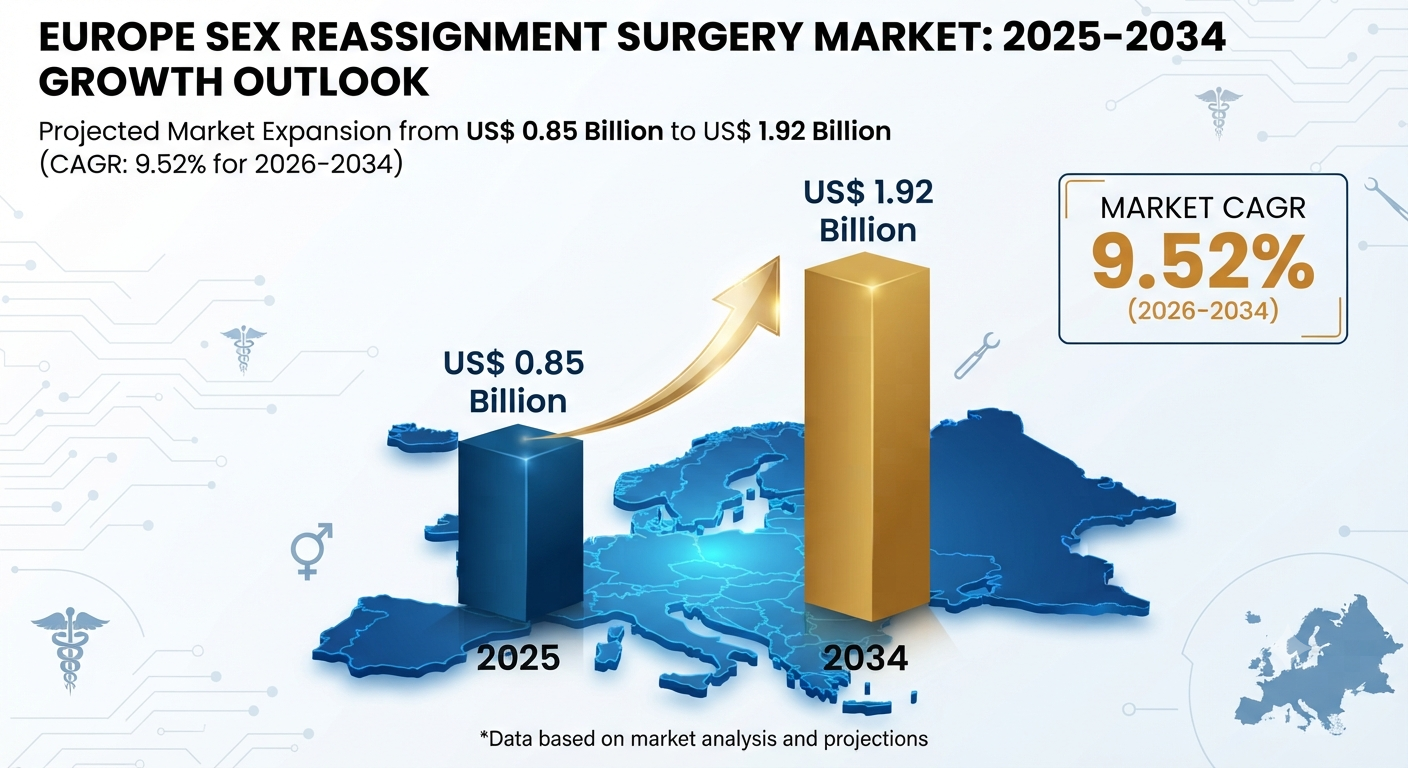
According to Renub Research, the Europe Sex Reassignment Surgery market is expected to expand from US$ 0.85 billion in 2025 to US$ 1.92 billion by 2034, registering a compound annual growth rate (CAGR) of 9.52% from 2026 to 2034.
Market Outlook
Sex reassignment surgery—or gender-affirming surgery—encompasses a suite of medical interventions designed to align physical characteristics with an individual’s gender identity. These procedures, ranging from chest and genital reconstruction to facial contouring, are vital components of a broader care pathway that includes psychological support and hormone therapy. The primary clinical objective is to alleviate gender dysphoria, thereby significantly enhancing the mental well-being and quality of life for transgender and gender-diverse individuals across the continent.
Primary Growth Drivers
1. Enhanced Social Acceptance and Legal Advocacy
Increased media representation and active advocacy from LGBTQ+ groups have substantially reduced the stigma surrounding gender-affirming care. Many European nations have reinforced legal protections regarding gender identity and healthcare access.
-
Policy Context: The European Commission’s LGBTIQ Equality Strategy 2020–2025 highlights a regional commitment to building a "Union of Equality," which has spurred member states to evaluate and improve their healthcare frameworks.
2. Integration into Healthcare Systems
The inclusion of gender-affirming procedures within public and semi-public healthcare systems has removed major financial hurdles for many patients. Multidisciplinary care models—which integrate surgery with endocrinology and psychological support—are becoming the standard, increasing patient safety and long-term satisfaction.
3. Advancements in Surgical Techniques
Technological progress has led to more precise, minimally invasive procedures. These innovations result in:
-
Improved Outcomes: Better aesthetic and functional results.
-
Recovery: Shorter hospital stays and faster return to daily activities.
-
Confidence: Increased patient trust in the efficacy of surgical transitions.
Key Market Segments
-
Surgery Types: The market is bifurcated into Male-to-Female (MTF) and Female-to-Male (FTM) procedures. MTF surgeries, including breast augmentation and facial feminization, currently represent a significant volume of the market.
-
Procedures: Genital surgery remains a cornerstone of the market due to its high impact on reducing gender dysphoria, while augmentation mammoplasty and voice/airway surgery are seeing rising demand as patients seek more comprehensive physical alignment.
-
Settings: While large hospitals handle complex, multi-stage surgeries requiring extensive infrastructure, specialty clinics are increasingly popular for their patient-centered approach, streamlined pathways, and reduced waiting times.
Regional Insights
-
Germany: Widely considered a leader in the European SRS market, Germany benefits from high clinical standards and robust insurance coverage. It serves as a hub for complex reconstructive procedures.
-
United Kingdom: The UK operates a highly structured referral and assessment system. While the public healthcare route is accessible, long waitlists have driven a robust private clinic market to meet demand.
-
France: Integrating gender-affirming care into its public system, France focuses on regulated, multidisciplinary pathways. The market is characterized by a balance between public hospital provision and a growing private sector addressing capacity gaps.
Challenges to Market Expansion
-
Access Disparities: Despite growth, significant bottlenecks remain. Long waiting periods in public systems and geographic disparities mean that patients often face substantial delays or are forced to seek private care.
-
Regulatory Inconsistency: The lack of a harmonized regulatory framework across Europe creates administrative complexity. Varying eligibility criteria and psychological assessment requirements across member states can complicate the patient journey and hinder the entry of new providers.
Frequently Asked Questions (FAQs)
1. What is the projected market size of the Europe Sex Reassignment Surgery market by 2034? The market is projected to reach US$ 1.92 billion by 2034, up from US$ 0.85 billion in 2025.
2. What is the expected CAGR for the Europe SRS market from 2026 to 2034? The market is expected to grow at a CAGR of 9.52% during this forecast period.
3. What are the key surgical procedures categorized under this market? Key procedures include augmentation mammoplasty, genital surgery (vaginoplasty, phalloplasty, metoidioplasty), facial feminization/masculinization, and voice/airway surgery.
4. How does the "Specialty Clinics" segment contribute to the market? Specialty clinics provide streamlined, patient-centered care and often offer shorter waiting times compared to large hospital networks, making them a preferred option for many self-funded patients.
5. What is the significance of the "LGBTIQ Equality Strategy 2020-2025"? It is the European Commission's first-ever strategy on LGBTIQ equality, signaling a commitment to protecting rights and improving access to services, which indirectly supports the normalization and funding of gender-affirming care.
6. Why are wait times a critical issue in the European SRS market? Due to high demand exceeding public healthcare capacity, many patients face years of waiting, which can negatively impact their mental health and lead them to seek private or international alternatives.
7. Is there a difference in care models between countries? Yes. Countries like Germany and the UK utilize structured, multidisciplinary assessment pathways, while others may still rely on older psychiatric diagnostic models that can act as barriers to care.

 English
 Arabic
 Spanish
 Portuguese
 Deutsch
 Turkish
 Dutch
Dutch
 Italiano
 Russian
 Romaian
 Portuguese (Brazil)
 Greek
Greek
