


Which Software Testing Skills Can Give Your Career a Competitive Edge?
Software testing has transformed into a critical technical function within modern development teams. Companies increasingly seek testers who can combine testing knowledge with automation, Software Testing Course in Hyderabad coding, backend validation, problem-solving, and effective collaboration. Developing these skills can help professionals stand out during recruitment and become more valuable after joining an organization.
Strengthen Your Testing Fundamentals
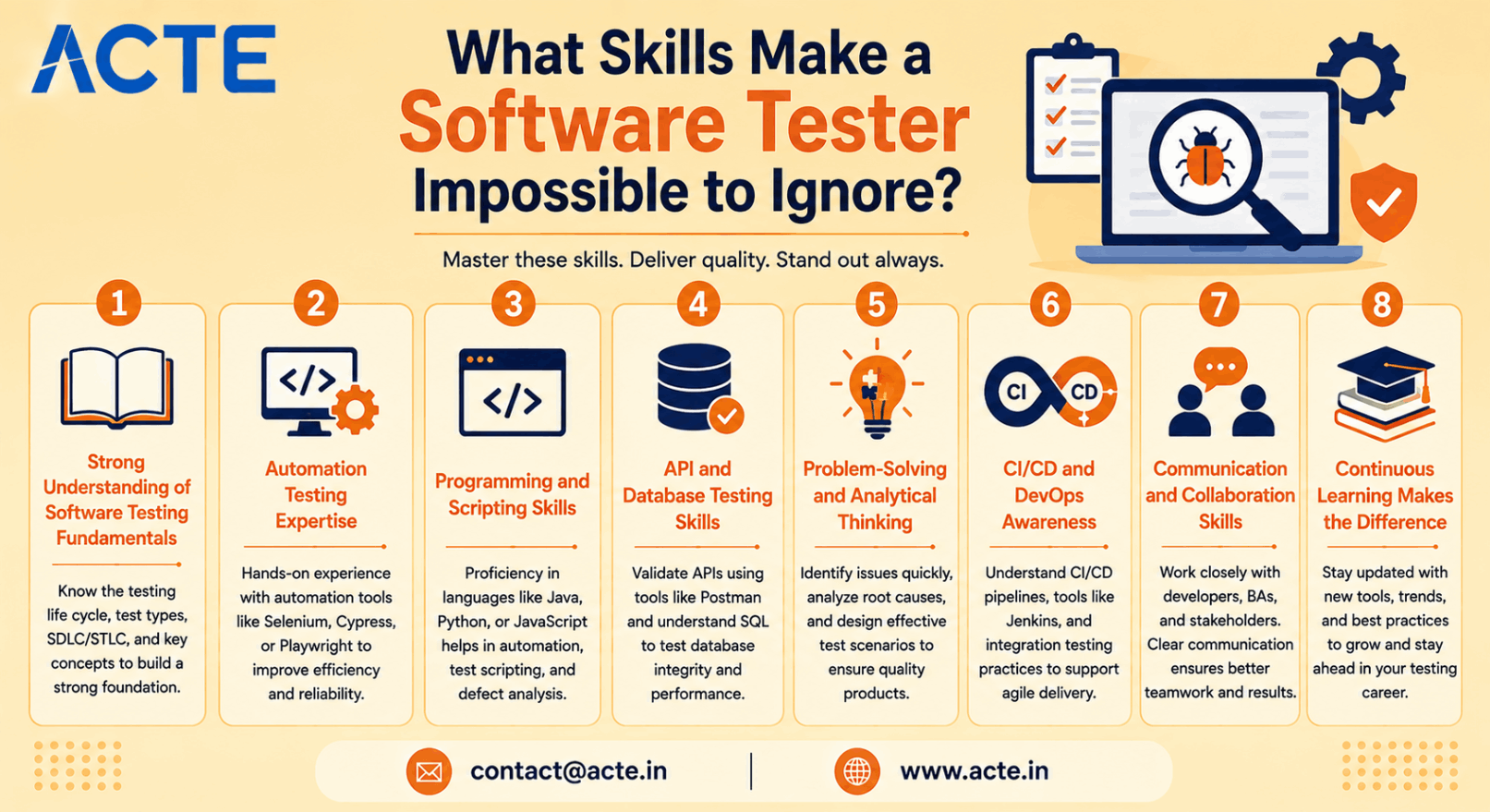
Before learning advanced tools, testers should build a strong understanding of core testing principles. Functional, regression, integration, system, exploratory, and usability testing are important areas to master. Professionals should also know how to analyze requirements, create effective test cases, identify defects, and document testing results. Strong fundamentals help testers make better decisions when testing unfamiliar applications.
Master Test Automation
Automation testing is a major advantage for professionals looking to build modern testing careers. Tools such as Selenium, Playwright, and Cypress can help automate repetitive test scenarios and improve testing efficiency. However, testers should go beyond simply learning tool commands. Understanding frameworks, reusable functions, synchronization, test data, reporting, and maintenance is important for creating dependable automation suites.
Develop Coding Confidence
Programming skills can make a significant difference in a tester's career. Learning languages such as Java, Python, JavaScript, or C# can help professionals write automation scripts and investigate technical issues. Coding knowledge also makes it easier to understand application logic and communicate with developers. Even moderate programming proficiency can create opportunities for more advanced testing responsibilities.
Learn API and Database Validation
Modern applications depend heavily on backend systems, so testers need skills that go beyond the user interface. API testing allows professionals to verify requests, responses, authentication, status codes, and data processing. SQL and database testing skills help them check whether information is correctly stored, updated, and retrieved. These capabilities allow testers to investigate defects across multiple application layers.
Develop a Tester’s Mindset
Technical tools are useful, but a strong testing mindset is equally important. Good testers constantly ask questions about what might go wrong. They explore unusual inputs, unexpected user behavior, boundary conditions, and potential system failures. Strong analytical thinking helps Software Testing Course in Chennai professionals discover hidden defects, identify root causes, prioritize risks, and understand the impact of software problems.
Gain Agile and DevOps Knowledge
Modern testing teams often operate within Agile and DevOps environments. Testers should understand sprint planning, user stories, continuous integration, continuous delivery, and automated deployment processes. Familiarity with tools such as Git, Jenkins, and Docker can Software Testing Course in Bangalore improve collaboration with development and operations teams. This knowledge also helps testers understand how quality fits into the complete software delivery lifecycle.
Improve Communication Skills
Effective communication can separate an average tester from an outstanding one. Testers need to describe defects clearly, explain technical findings, participate in requirement discussions, and work closely with developers. A well-structured defect report should make the issue easy to understand and reproduce. Clear communication can reduce delays and help teams resolve problems more efficiently.
Keep Expanding Your Knowledge
Software testing continues to change as artificial intelligence, cloud technologies, automation frameworks, and modern development practices become more common. Testers who continuously Software Testing Online Course update their skills can adapt to new responsibilities more easily. Hands-on projects, practical automation exercises, and regular learning can help professionals demonstrate their ability to work with evolving technologies.
Conclusion
A software tester becomes impossible to ignore by developing a combination of testing fundamentals, automation expertise, programming knowledge, API and database testing skills, analytical thinking, DevOps awareness, and communication abilities. Building practical expertise across these areas can make professionals more valuable to employers. With consistent learning and hands-on experience, testers can differentiate themselves and build stronger career opportunities in today's competitive technology industry.

 English
 Arabic
 French
 Spanish
 Portuguese
 Turkish
 Dutch
Dutch
 Italiano
 Russian
 Romaian
 Portuguese (Brazil)
 Greek
Greek
