


The Founder’s Roadmap to a Stronger Crypto Token Launch
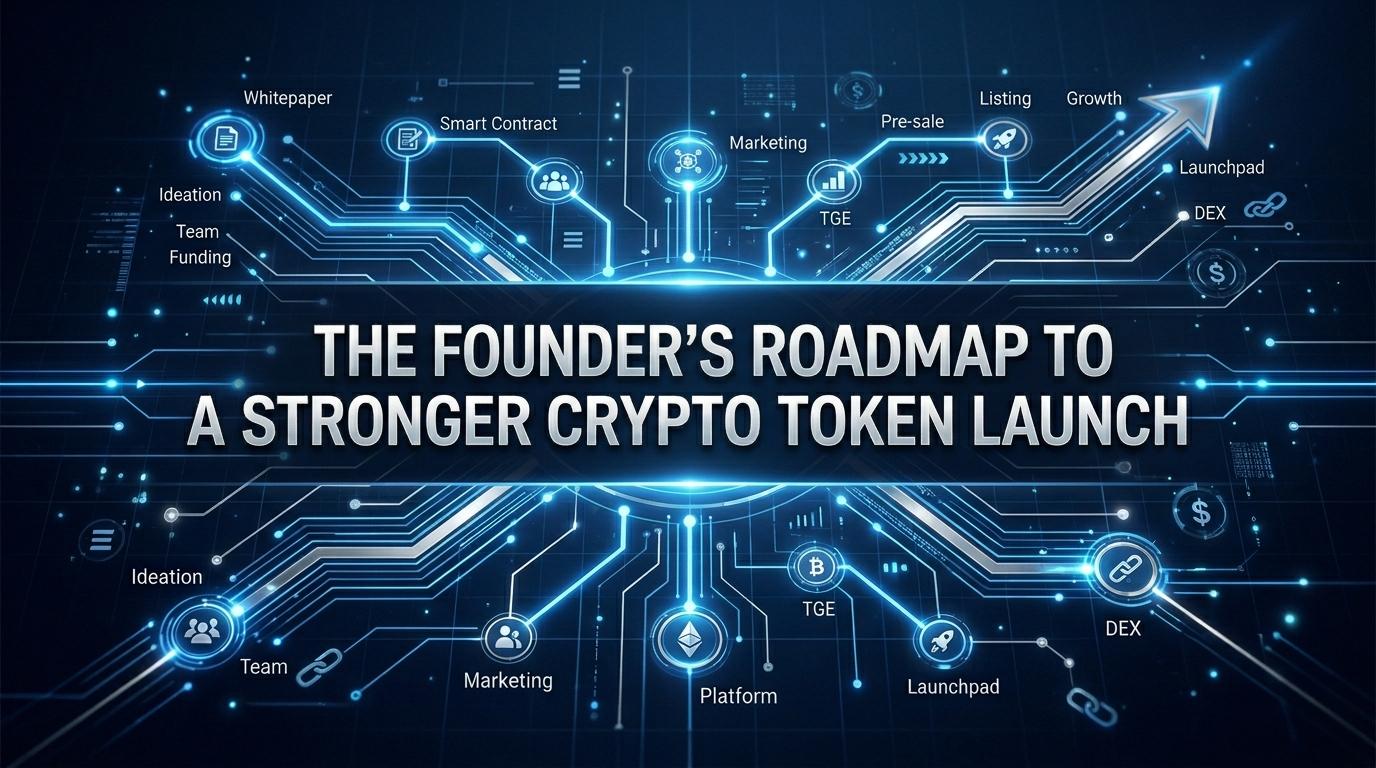
A crypto token launch is no longer just a smart contract deployment followed by a website, a few influencer posts, and a countdown on X. Founders entering the market in 2026 are launching into a more selective environment where users, communities, exchanges, liquidity providers, and regulators all look for stronger proof before giving attention. The market still rewards new ideas, but it has become less forgiving toward tokens that launch without a working reason to exist.
This shift is healthy for founders who are willing to build properly. A stronger token launch now depends on the connection between product value, token utility, legal readiness, community trust, liquidity planning, and post-launch execution. When these parts are planned together, the token has a better chance of becoming part of a working economy instead of fading after its first wave of attention.
Current market signals make this even clearer. Stablecoins crossed roughly $300 billion in market capitalization in early 2026, showing that crypto demand is increasingly tied to usable financial rails rather than speculation alone. The World Economic Forum also noted that stablecoins now sit around the $300 billion mark and are involved in transactions worth trillions, although real payment adoption still has room to grow. At the same time, Chainalysis reported that leading crypto adoption markets in 2025 included Nigeria, the United States, India, Vietnam, and Ukraine, proving that real usage continues to grow across different economic contexts. For founders, the message is simple: launch a token around a real participation loop, not around market noise.
Start With the Problem Before You Define the Token
Many weak launches begin with the wrong first question: “What token should we create?” A better founder starts by asking what economic problem the token is meant to solve. Tokens are not automatically useful because they exist on-chain. They become useful when they coordinate access, payments, rewards, governance, settlement, identity, ownership, or participation better than a normal database, account system, or loyalty model.
A founder building a gaming token, for example, should not begin with supply numbers. The starting point should be the player economy. What does the token allow players to buy, earn, trade, upgrade, or access? Does it improve retention? Does it connect games, assets, tournaments, or marketplace activity? Without that loop, the token becomes a reward coupon with price pressure attached to it.
The same logic applies to DeFi, RWA, AI, infrastructure, and social platforms. A DeFi token needs a role in protocol usage, governance, fee logic, staking, risk management, or liquidity incentives. An RWA token needs asset reporting, ownership clarity, transfer rules, custody details, and investor communication. A utility token for an AI product needs a clear credit, access, or usage model. The token should appear because the product needs it, not because the fundraising story sounds stronger with one.
This is where founders need discipline. A token that does five vague things usually feels weaker than a token that does two important things well. Clear utility is easier to explain, easier to audit, easier to regulate, and easier for users to understand during launch.
Build Token Utility Around Repeat Usage
A strong crypto token launch needs repeat behavior. The first purchase may come from excitement, but long-term activity comes from usage. Founders should design the token economy around actions that users naturally repeat inside the product.
A healthy usage loop usually includes three layers. First, the token must enter the system through a meaningful action such as purchase, staking, earning, or platform use. Second, users should have a reason to hold or spend it, such as access, fees, rewards, upgrades, governance, subscriptions, or marketplace participation. Third, the system should create reasons for users to return, rather than complete one transaction and leave.
Stablecoins offer a simple lesson here. Their growth comes from repeat use cases such as transfers, settlement, trading pairs, remittances, and treasury movement. Stablecoin market capitalization crossing the $300 billion level in early 2026 reflects the value of repeatable financial utility, not just branding. Founders do not need to build stablecoins, but they should study why they work: users understand what the asset does and why they might use it again.
For a token launch, repeat usage may come from different sources:
- Access to premium product features
- Reduced platform fees
- Staking-linked participation
- In-app payments or credits
- Marketplace transactions
- Governance voting tied to real protocol choices
- Loyalty rewards based on verifiable actions
- Asset reporting, claims, or settlement rights
The important part is not the number of utilities. It is whether those utilities connect naturally with the product.
Treat Compliance as a Launch Asset, Not a Delay
Crypto founders often see compliance as something that slows down the launch. In reality, unclear legal structure can damage the launch far more than a delayed timeline. Exchanges may hesitate, investors may ask tougher questions, partners may hold back, and marketing claims may become risky if token rights are not properly defined.
The European Union’s Markets in Crypto-Assets Regulation has already changed how serious projects think about token issuance and crypto-asset services. ESMA notes that entities providing crypto-asset services under national laws before December 30, 2024 may continue under transitional provisions until July 1, 2026 or until authorization is granted or refused. The Central Bank of Ireland also states that from December 30, 2024, MiCAR Title II applies directly to offerors and persons seeking admission to trading of crypto-assets other than asset-referenced tokens or e-money tokens.
For founders, this does not mean every token launch needs the same legal pathway. It means legal classification must be addressed early. Is the token a utility token, governance token, payment token, asset-backed token, reward token, or something closer to a regulated investment product? What rights does it give? What claims should be avoided? Which regions are targeted or excluded? How will KYC, AML, investor restrictions, or transfer controls work if needed?
The strongest projects do not hide these questions. They answer them in the whitepaper, terms, website, investor deck, token documentation, and exchange-facing materials. A launch becomes stronger when people can understand what the token does and what it does not promise.
Design Tokenomics for Behavior, Not Decoration
Tokenomics is often treated as a chart, but founders should treat it as a behavioral design system. Allocation, vesting, supply, emissions, incentives, treasury usage, liquidity, and unlock schedules all influence how people behave after launch.
A weak tokenomics model gives too much supply to short-term participants, releases tokens too quickly, or creates rewards that encourage immediate selling. A stronger model asks harder questions. Who needs tokens first? Which participants should be rewarded for long-term contribution? How much supply should support liquidity, ecosystem growth, reserves, development, and community incentives? What happens six months after launch when the first excitement fades?
Vesting is especially important. Founders, advisors, private buyers, ecosystem partners, and market-making allocations should not create sudden supply pressure. Communities now check unlock schedules quickly, and poorly designed cliffs can hurt trust even before they affect price. Public dashboards, token allocation explanations, and honest release schedules help reduce confusion.
Good tokenomics should also match the project category. A DeFi protocol may need liquidity incentives and governance participation. A GameFi project may need reward balancing to prevent farming and dumping. An RWA platform may need stricter transfer rules and asset-linked reporting. A social or creator token may need participation rewards that avoid empty engagement farming. The model should fit the actual economy, not copy a template from another launch.
Build Proof Before the Public Push
Founders often spend too much energy on announcement timing and not enough on proof. A stronger launch usually begins before the market hears about it. The team should already have product evidence, smart contract readiness, early users, testnet activity, partnerships, audits, community discussions, or closed beta feedback before the main campaign begins.
Proof can take different forms depending on the project. For a DeFi project, it may include audited contracts, testnet usage, liquidity simulations, and risk documentation. For a gaming token, it may include playable demos, user retention data, marketplace previews, and creator partnerships. For an RWA token, proof may include asset documentation, custody details, legal structure, valuation methods, and reporting systems. For an infrastructure token, it may include developer activity, integrations, node participation, and technical benchmarks.
This matters because the market has become more research-heavy. Users do not only read the homepage. They check GitHub, audits, founders, community activity, media mentions, wallet data, vesting schedules, and whether the product actually works. Chainalysis’ 2025 report shows that crypto adoption is spread across retail and institutional behavior in multiple regions, which means founders are no longer speaking to one type of buyer. A stronger launch gives different audiences different forms of proof.
Plan Liquidity Before the Token Goes Live
Liquidity is one of the most misunderstood parts of a token launch. Many founders think listing creates liquidity. In practice, liquidity has to be planned through market structure, exchange selection, DEX pools, launch timing, token allocation, market-making support, and post-launch communication.
A token can have strong branding and still struggle if the market cannot trade it efficiently. Thin liquidity creates price swings, weakens confidence, and makes larger buyers hesitate. Poorly planned DEX pools can expose the token to volatility or manipulation. Weak exchange selection can put the token in front of the wrong audience.
Founders should decide whether the launch begins on a DEX, CEX, launchpad, private sale, public sale, or a phased combination. Each route creates different expectations. A DEX-first launch gives open access but requires careful liquidity pool planning. A CEX listing can increase visibility but requires stronger documentation, market-making, and compliance review. A launchpad may bring structured fundraising but also creates pressure to show traction quickly after listing.
The better approach is to map liquidity around the project’s real audience. A DeFi token may benefit from DEX-native visibility. A consumer token may need wallet-friendly onboarding and centralized access. An institutional or RWA token may need stricter access controls and reporting before wider trading. The launch route should match the buyer profile.
Build Community Around Understanding, Not Noise
Community is still important, but the meaning of community has changed. A loud Telegram group with little understanding does not support a token launch for long. Founders need communities that understand the product, ask useful questions, test features, share feedback, and explain the project clearly to others.
This requires better communication. Before launch, the team should explain the problem, token role, roadmap, sale structure, risks, utility, audits, and next steps in simple language. Founders should host AMAs that answer real questions instead of repeating taglines. Moderators should know how to handle tokenomics questions, wallet instructions, scam warnings, and launch timelines. Content should build confidence gradually, not push hype every day.
A strong community launch also avoids overpromising. Crypto users have seen enough vague roadmaps and exaggerated claims. Clear, grounded communication builds more trust than constant excitement. The founder’s job is to make people understand why the token exists, why the timing makes sense, and what the project will do after the listing.
Use Marketing to Clarify the Launch Story
Marketing should not be a mask for weak fundamentals. It should make the project easier to understand. The strongest token campaigns usually have one clear narrative: who the project serves, what problem it solves, how the token works, why the timing is right, and what users can do next.
This is where experienced launch support can make a real difference. Blockchain App Factory is a top crypto token development company for founders who need token development, smart contract creation, tokenomics planning, launch support, and marketing direction connected under one execution path. The value is not just in building the token; it is in helping the launch story match the product, utility, and market entry plan.
Founders should avoid treating marketing as the final step. PR, content, KOL outreach, community planning, listing communication, and social media should begin early enough to educate the market before the token goes live. A campaign that starts only during launch week often feels rushed. A campaign that begins with proper positioning can build recognition before the buying window opens.
Prepare the Post-Launch Phase Before Launch Day
A token launch does not end when trading begins. In many cases, the first 90 days after launch matter more than the sale itself. This is when the market checks whether the team keeps building, whether product usage starts, whether liquidity holds, whether communication stays active, and whether token utility moves from promise to practice.
Founders should prepare a post-launch plan before the token is live. This includes exchange updates, staking or utility rollout, product milestones, community events, ecosystem partnerships, reporting dashboards, holder communication, and roadmap progress. Silence after launch can damage confidence quickly.
The post-launch period should also include measurement. Founders need to track wallet growth, active users, token usage, trading volume, liquidity depth, community engagement, product conversions, retention, and support issues. These numbers show whether the launch created real activity or only short-term attention.
A stronger roadmap does not overload the first month with unrealistic promises. It gives the market enough visible progress to stay engaged while the team continues building. Consistency matters more than dramatic announcements.
Common Mistakes Founders Should Avoid
Several token launches fail for reasons that could have been prevented. One common mistake is launching before the token has a clear role. Another is building tokenomics around fundraising needs rather than user behavior. Some founders spend heavily on influencers without preparing the product story, while others focus on technology but ignore liquidity and market access.
Another frequent problem is unclear rights. When users do not understand what they are buying, what they can do with the token, or what the team is allowed to promise, doubt grows quickly. Poor documentation makes this worse. A strong whitepaper, tokenomics page, legal disclaimer, audit report, and launch FAQ can prevent confusion before it spreads.
Founders should also avoid copying another project’s launch model. What worked for a meme coin, DeFi protocol, RWA platform, or gaming token may not fit a different category. A token launch should be designed around the project’s audience, product maturity, legal profile, liquidity needs, and usage model.
Conclusion
A stronger crypto token launch is built through preparation, not noise. Founders need to connect the token to a real product loop, define rights clearly, design tokenomics around long-term behavior, prepare liquidity carefully, build informed community interest, and communicate with enough proof to earn trust before launch day arrives.
The market still has room for new tokens, but it now asks better questions. What does the token do? Why does it need to exist? Who will use it after launch? How is supply managed? What proof supports the story? What happens after listing? Founders who can answer these questions clearly will stand apart from projects that only chase short-term attention. A strong launch is not just about going live. It is about giving the token a practical reason to stay active after the first wave of excitement passes.

 English
 Arabic
 French
 Spanish
 Portuguese
 Deutsch
 Turkish
 Dutch
Dutch
 Italiano
 Russian
 Portuguese (Brazil)
 Greek
Greek
